
Probably Gauss (1777 - 1855) is my favorite mathematician of all times. He certainly doesn't have the historic repercussion of Newton or Einstein, but I've always been amazed by his contributions to science.
 |
| Carl Friedrich Gauss |
Ovbiously calling him just a mathematician wouldn't be fair at all, as there are many fields in which he contributed, as most geniouses from the past have.
Since very early age, he was very good with numbers and showed an interest in arithmetic and also linguistics. At the age of 3, his father was calculating the salary of his workers with little Gauss watching closely. When he was finished, his son said to him: "Father, your calculations are wrong, the correct result is...". His father checked and he was right, but the most amazing thing is that nobody had taught him how to read. But probably his most famous story is when he was around 9 years old. His arithmetics teacher asked the class to calculate the sum of the first 100 numbers, and Gauss, instead of adding each number one by one, realized almost instantly that this was, in fact, the same as adding 50 pairs of 101 each (1+101, 2+99...).
One of his first and most significant works was to discover the law the the least squares fitting. This is a mathematical procedure for finding the best-fitting curve to a given set of points by minimizing the sum of the squares of the offsets of the points from the curve.

One of his first and most significant works was to discover the law the the least squares fitting. This is a mathematical procedure for finding the best-fitting curve to a given set of points by minimizing the sum of the squares of the offsets of the points from the curve.
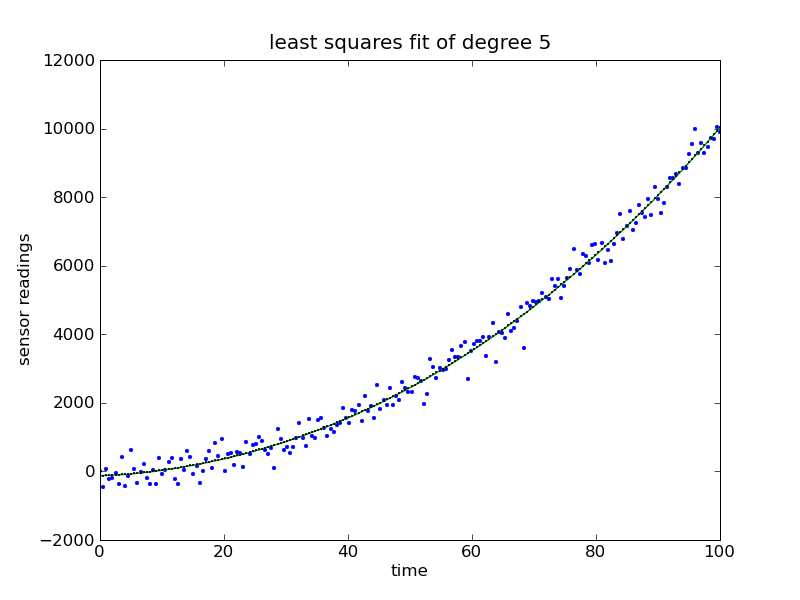
This lead to a situation that will earn Gauss the position of Director of Göttingen's Observatory. Ceres, a new small planet discovered by an italian astronomer, had dissapeared behind the Sun, and only 9 degrees of its orbit had been followed. Gauss used this data and his Least Squares method to predict with outstanding accuracy the position of the asteroid.
Another great discovery at the time was the demonstration that a 17 side regular poligon could be drawed with just a ruler and compass, and the general case that this could only be done with poligons with a number of sides of the form 2^n or 2^(2^n)+1. This problem had been around since the greeks, and many mathematicians throughout history had unsuccessfully tried to solve it.
He proposed the Fundamental Theorem of Algebra, where he demonstrates that every polynomial has a root of the form a+bi, and that a degree n polynomial has n real roots. He also proved the Fumdamental Theorem of Arithmetics, which states that every natural number can be represented as the product of primes in only one way.
Gauss was also devoted to number theory and geodesy, and his publications all had one thing in common, his highly rigorous demonstrations. This caused many of his work to remain unpublished until after his death, even some were discovered many years later.
Defenitely one of the greatest minds of all times, I hope you learned a little bit more about this genius.

No hay comentarios:
Publicar un comentario